


SC: Cooperative Bye Laws Upheld, Election Disputes Confined To Forum
 Copy Link
 Share
Share Save
Save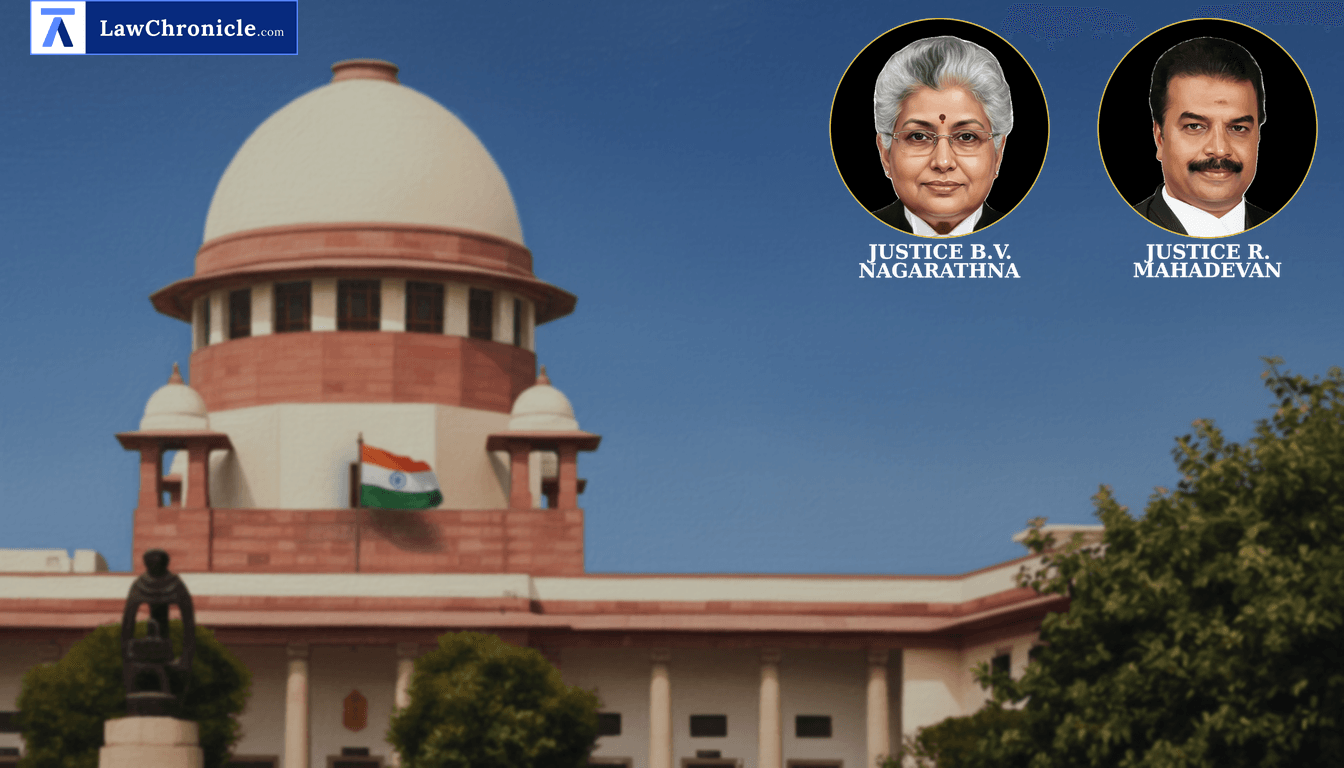
A bench of Justice B.V. Nagarathna and Justice R. Mahadevan heard an appeal challenging a Division Bench judgment of the High Court of Rajasthan that had declared several eligibility bye‑laws of District Milk Producers’ Co‑operative Unions ultra vires the Rajasthan Co-Operative Societies Act, 2001, and questioned the maintainability of writ petitions under Article 226 of the Constitution of India, 1950. The appeal concerned whether internal electoral qualifications framed by the Unions could be adjudicated by the High Court or must be routed through the statutory machinery under the Act.
In its decision the Court allowed the appeal, set aside the impugned High Court orders and held that the validity of bye‑laws prescribing eligibility to contest and to represent member societies was to be assessed within the legislative scheme. The Court emphasized the availability of a comprehensive adjudicatory code under Section 58 and related provisions of the Rajasthan Co-Operative Societies Act, 2001 and the doctrinal distinction between the right to vote and the right to contest.
The Court, in its reasoning, observed: "Section 58(1) of the Act, 2001 confers exclusive jurisdiction upon the Registrar to decide disputes ‘touching the constitution, management or the business of a co‑operative society’ and by necessary implication, excludes the jurisdiction of civil courts in respect of such disputes. The scope of this provision is further widened by Section 58(2)(c), which categorically declares that any dispute arising in connection with the election of an officer of a society shall be deemed to be a dispute touching its constitution or management. Section 58(3) accords finality to the Registrar’s determination as to whether a dispute falls within the ambit of the provision." The Court also noted verbatim that "In view of the aforesaid discussion, we are of the considered opinion that the writ petitions ought not to have been entertained in the exercise of jurisdiction under Article 226 of the Constitution of India, 1950." The consequence was that the High Court’s in‑rem invalidation across all Unions was set aside and the matter was returned to the statutory forums; "Accordingly, this appeal stands allowed. The impugned judgment and order of the High Court are set aside."
Background
The dispute arose when certain Primary Milk Producers’ Societies challenged Bye‑laws 20.1(2), 20.1(4), 20.2(7) and 20.2(9) of District Milk Unions as being ultra vires the Rajasthan Co-Operative Societies Act, 2001. A learned Single Judge upheld the writ petitions and the Division Bench affirmed that decision. The appellants, chairpersons of several District Unions who had not been impleaded in the writs, appealed to this Court. The appellants contended that the Unions were private cooperative bodies and that writ jurisdiction under Article 226 was not tenable against them, relying in submissions on Federal Bank Ltd v. Sagar Thomas and on the distinction drawn in Ajay Hasia v. Khalid Mujib Sehravardi for testing when a body is an instrumentality of the State. The Court applied the tests from Ajay Hasia v. Khalid Mujib Sehravardi, General Manager, Kishan Sahkari Chini Mills Ltd. v. Satrughan Nishad and others, Thalappalam Service Co-operative Bank Ltd. and others v. State of Kerala and others and Federal Bank Ltd v. Sagar Thomas to conclude that the District Milk Unions did not, on the materials, qualify as “State” under Article 12.
On remedies the Court held that the petitioners had bypassed an efficacious statutory scheme: Section 58(2)(c), Section 60 and execution and appellate provisions such as Section 100, 104‑107 of the Rajasthan Co-Operative Societies Act, 2001 created a complete machinery. The Court relied on the principle in Titaghur Paper Mills Co. Ltd. v. State of Orissa and followed the reasoning in Umesh Shivappa Ambi and others v. Angadi Shekara Basappa and others and Naresh Chandra Agrawal v. ICAI to hold that where such special remedies exist, writ jurisdiction should not be invoked absent exceptional circumstances. With respect to the nature of the contested rights, the bench reiterated the settled distinction between franchise and candidature, drawing upon Jyoti Basu and others v. Debi Ghosal and others, Javed and other v. State of Haryana and others, K. Krishna Murthy v. Union of India and Supreme Court Bar Association v. B.D. Kaushik to explain that the right to contest may be subject to reasonable eligibility criteria. The Court analysed the nature of bye‑laws through authorities such as Co-operative Central Bank v. Additional Industrial Tribunal, A.P. Dairy Development Corporation Federation v. B. Narasimha Reddy and others and Dattatreya v. Mahaveer, and applied the tests for validity of subordinate legislation in State of T.N. v. P. Krishnamurthy and Naresh Chandra Agrawal v. ICAI, while noting that regulatory conditions with intelligible differentia were permissible as held in Noel Harper v. Union of India.
The Court found that the impugned provisions were framed under Section 8 read with Schedule B (Clauses (da) and (v)) of the Rajasthan Co-Operative Societies Act, 2001, and that the bye‑laws prescribed eligibility linked to participation and service‑utilisation rather than creating penal disqualifications under Section 28. It held that the High Court had conflated eligibility with disqualification and erred in treating participation criteria as a constitutional or statutory breach. The Court further found procedural infirmity in the High Court’s broad in‑rem order because similarly placed Unions were not heard, relying on the principles in Dattatreya v. Mahaveer and High Court Bar Association Allahabad v. State of U.P. concerning non‑joinder and audi alteram partem. In consequence, the High Court’s declaration was set aside, and the disputes were left to the Registrar and the appellate tribunals under the Rajasthan Co-Operative Societies Act, 2001.
Case Details:
Case No.: CIVIL APPEAL NO. 4352 OF 2026
NeutralCitation: 2026 INSC 347
Case Title: RAM CHANDRA CHOUDHARY & ORS v. ROOP NAGAR DUGDH UTPADAK SAHAKARI SAMITI LIMITED AND OTHERS
Appearances:
For the Petitioner(s): Mr. Kapil Sibal (Senior Counsel)
For the Respondent(s): Learned counsel for Respondent No.2; Learned Standing Counsel for Respondent No.3
Source: 2026 CaseBase(SC) 307
 Breaking News